
 Image 1 of 2
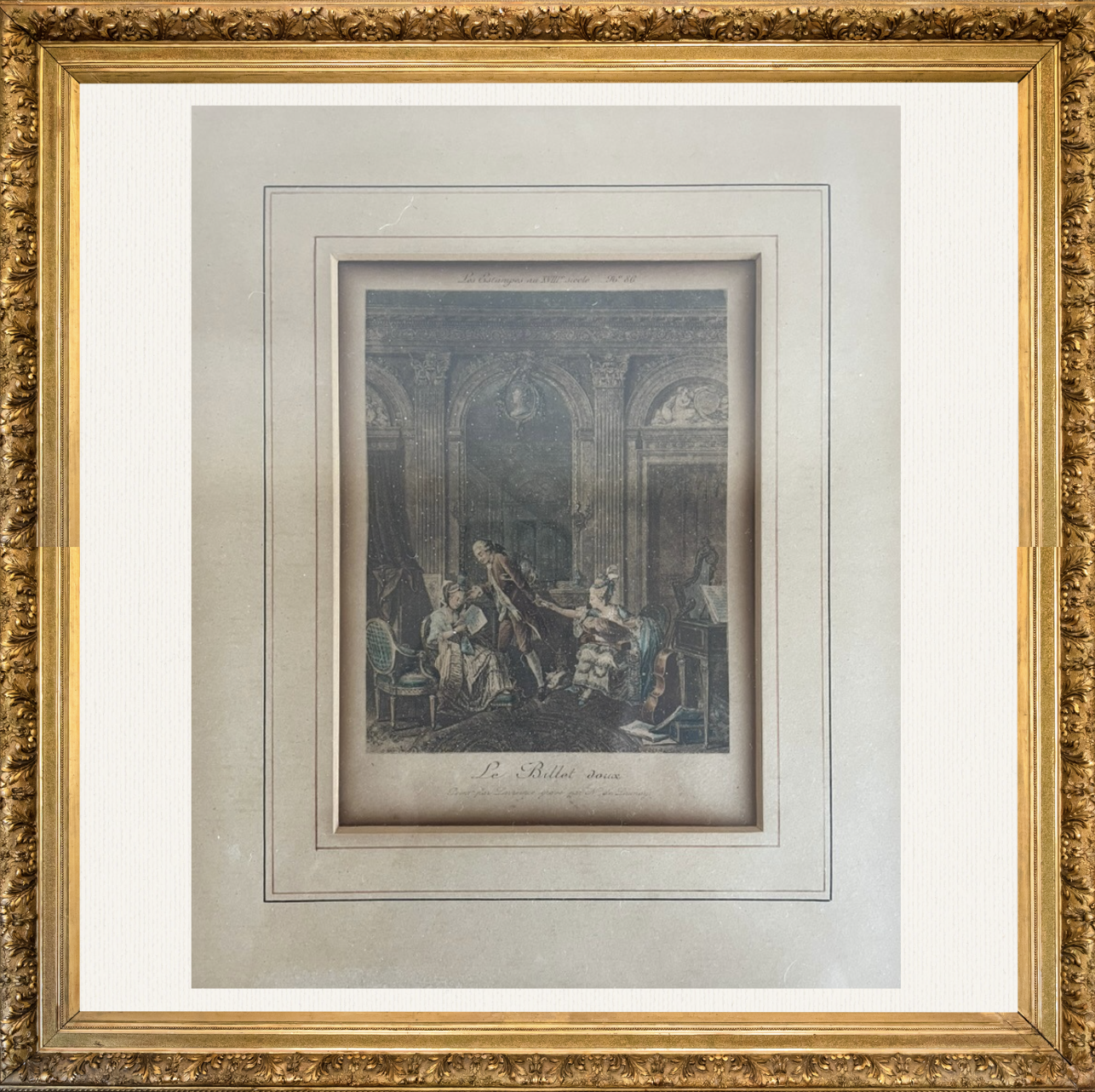 Image 2 of 2
Nicolas de Launay — Le Billet Doux
18th century engraving, after Jean-Honoré Fragonard
France
A beautifully detailed 18th century engraving by renowned French printmaker Nicolas de Launay (1739–1792), after the original painting Le Billet Doux (The Love Letter) by Jean-Honoré Fragonard (1732–1806) — master of Rococo art.
The scene captures an intimate moment of aristocratic life: a young woman receiving a secret letter, amidst the refined opulence of her salon — an image rich with romance, intrigue, and period charm.
Launay’s engravings are celebrated for their exquisite technique — fine detail, tonal subtlety, and an ability to translate the painterly qualities of Rococo into the print medium.
This piece is a fine example of 18th century French engraving — both as an art form and as a window into the culture and aesthetics of the Ancien Régime.
Details
• Engraving by Nicolas de Launay
• Titled Le Billet Doux
• After the original painting by Fragonard
• Published late 18th century, Paris
• Professionally framed under glass (vintage frame)
• Visible engraving approx. 14 cm x 19 cm
• Frame size approx. 35 cm x 42.5 cm
• Age-related toning to mat and light foxing — in keeping with the piece’s character and history
A Note on Nicolas de Launay
One of the leading French engravers of the late 18th century, Nicolas de Launay is renowned for his refined interpretations of Rococo and Neoclassical art.
Working alongside artists such as Fragonard, Greuze, and Moreau, Launay helped disseminate French visual culture across Europe — his engravings prized both for technical mastery and artistic sensitivity.
Nicolas de Launay — Le Billet Doux
18th century engraving, after Jean-Honoré Fragonard
France
A beautifully detailed 18th century engraving by renowned French printmaker Nicolas de Launay (1739–1792), after the original painting Le Billet Doux (The Love Letter) by Jean-Honoré Fragonard (1732–1806) — master of Rococo art.
The scene captures an intimate moment of aristocratic life: a young woman receiving a secret letter, amidst the refined opulence of her salon — an image rich with romance, intrigue, and period charm.
Launay’s engravings are celebrated for their exquisite technique — fine detail, tonal subtlety, and an ability to translate the painterly qualities of Rococo into the print medium.
This piece is a fine example of 18th century French engraving — both as an art form and as a window into the culture and aesthetics of the Ancien Régime.
Details
• Engraving by Nicolas de Launay
• Titled Le Billet Doux
• After the original painting by Fragonard
• Published late 18th century, Paris
• Professionally framed under glass (vintage frame)
• Visible engraving approx. 14 cm x 19 cm
• Frame size approx. 35 cm x 42.5 cm
• Age-related toning to mat and light foxing — in keeping with the piece’s character and history
A Note on Nicolas de Launay
One of the leading French engravers of the late 18th century, Nicolas de Launay is renowned for his refined interpretations of Rococo and Neoclassical art.
Working alongside artists such as Fragonard, Greuze, and Moreau, Launay helped disseminate French visual culture across Europe — his engravings prized both for technical mastery and artistic sensitivity.